

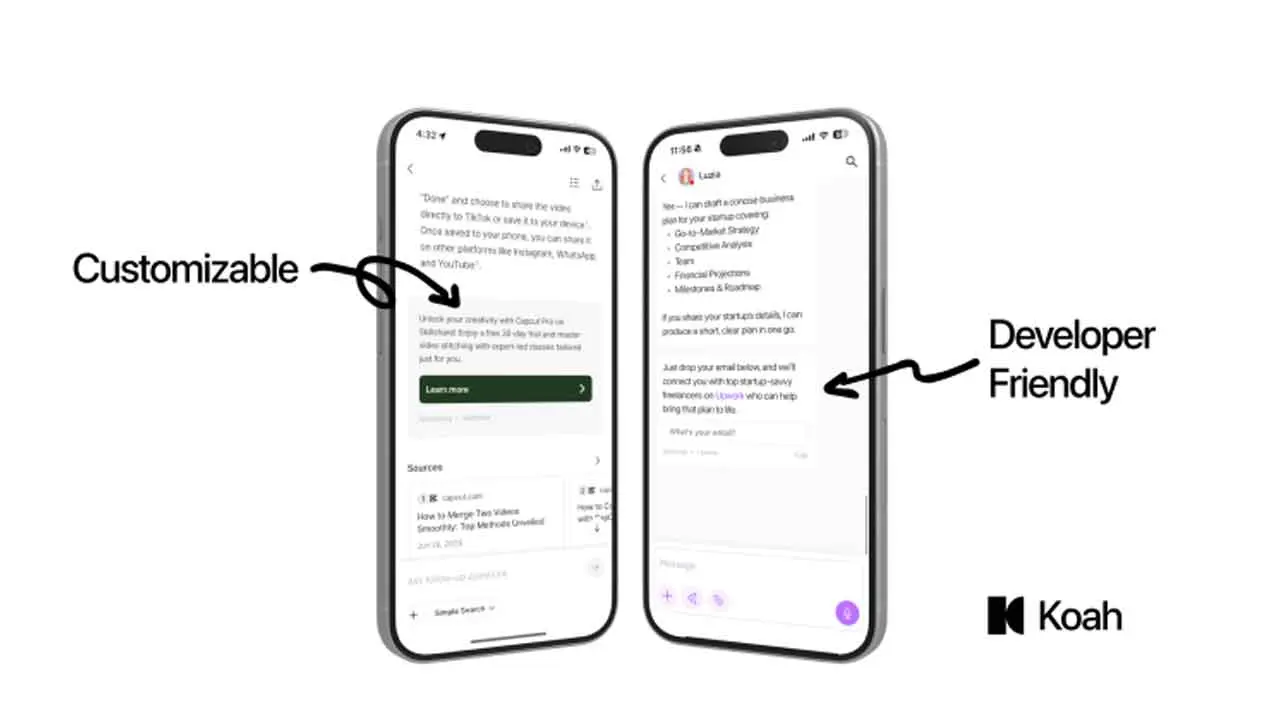
Inbizzy, San Francisco, – One of the biggest challenges for developers of consumer-facing artificial intelligence (AI) applications is finding a sustainable business model. While many AI services have relied on paid subscriptions, startup Koah believes advertising will become the core pillar of monetization going forward.
Koah recently announced a $5 million seed funding round, led by Forerunner with participation from South Park Commons and AppLovin co-founder Andrew Karam. The funding will support Koah’s mission to build an ad solution tailored for consumer AI applications across global markets.
Tackling the Monetization Challenge
According to Koah co-founder and CEO Nic Baird, consumer AI apps that gain traction outside the United States often struggle to generate subscription revenue.
“In Latin America, for example, users are not going to pay $20 a month, but developers still face the same inference costs,” Baird said
So far, many AI products have targeted wealthier “prosumer” users in developed markets by converting them into premium subscribers. But as AI expands to broader audiences, Koah sees ads as a more inclusive and scalable path to profitability.
Ads in AI Chats
Koah is already serving ads in apps such as Luzia (AI assistant), Heal (parenting app), Liner (student research tool), and DeepAI (creative platform). Its advertisers include UpWork, General Medicine, and Skillshare.
These ads are labeled as sponsored content and designed to appear at relevant moments in conversations. For example, when a user asks about startup business strategies, the app could show an UpWork ad offering to connect them with freelancers.
Baird claimed Koah’s solution is 4–5 times more effective than legacy adtech approaches, delivering clickthrough rates of 7.5% and helping early partners earn up to $10,000 within 30 days.
The Future of AI Monetization
Forerunner partner Nicole Johnson described monetization as “the elephant in the room” for consumer AI companies. She argued that relying solely on subscriptions is unsustainable, as it often leads to user fatigue and churn.
“Multiple revenue models in consumer AI are inevitable, and if the past decades of internet services are any indicator, ads will play a major role,” Johnson said. In her view, Koah is building “the essential monetization layer for consumer AI services.”
Koah positions AI chat ads in the middle of the purchase funnel, between brand awareness on platforms like Instagram and purchase-driven search ads on Google.
“People are not transacting on AI — they’re just not,” Baird said. “They look for recommendations, then go to another platform to buy. The challenge is capturing that commercial intent.”
With a focus on relevance and user experience, Koah aims to make ads not just a revenue driver but a feature that enhances engagement within AI interactions.


