

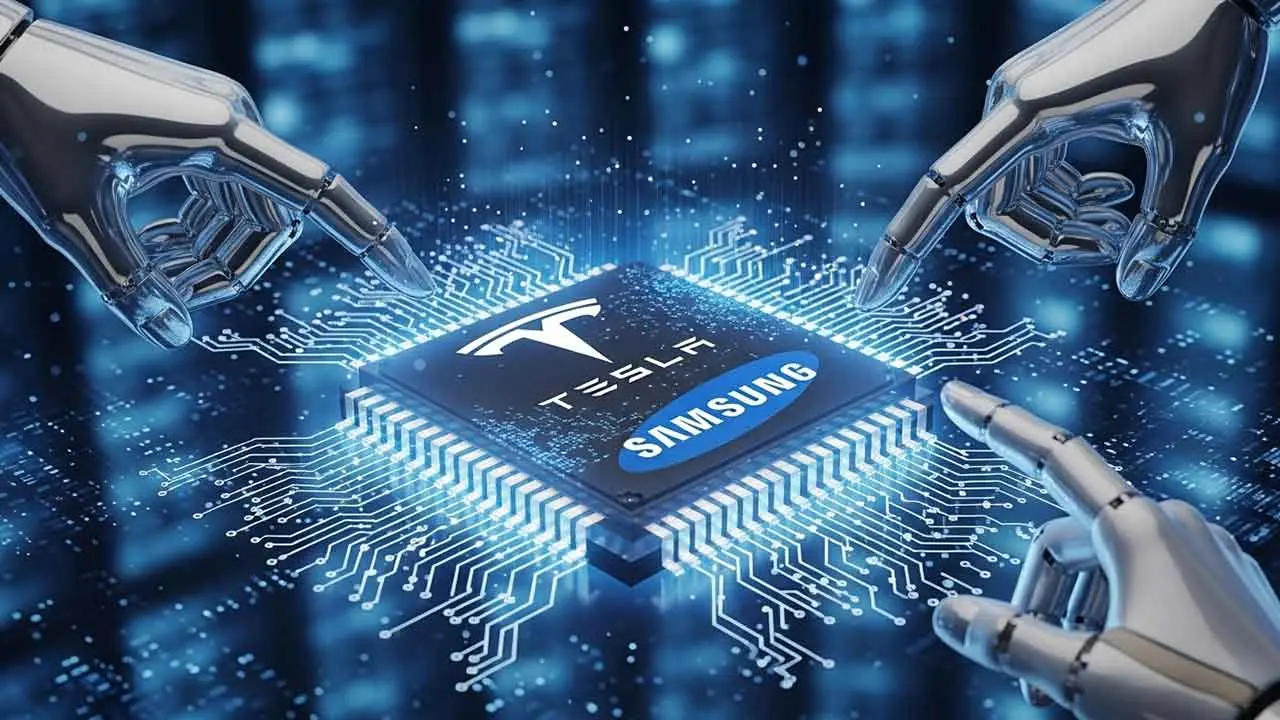
Inbizzy, – Tesla and Samsung Electronics have officially signed a chip supply agreement worth $16.5 billion, a strategic long-term partnership set to run until the end of 2033. This deal marks one of the largest contracts in Samsung’s foundry history and underscores a major leap in AI chip development for the automotive sector.
Next-Gen AI Chip for Tesla’s Self-Driving Future
The agreement involves the production of Tesla’s next-generation AI chip, the A16, to be fabricated at Samsung’s advanced facility in Taylor, Texas. The chip is custom-built to power Tesla’s Full Self-Driving (FSD) technology, AI data centers, and the company’s humanoid robot project, “Optimus.”
“Samsung agreed to allow Tesla to assist in maximizing manufacturing efficiency. … I will walk the line personally to accelerate the pace of progress. And the fab is conveniently located not far from my house,”
— Elon Musk, CEO of Tesla, via Reuters https://www.reuters.com/business/musk-says-tesla-samsung-electronics-sign-165-billion-chip-supply-deal-2025-07-28/
Musk added that the $16.5 billion figure is a conservative estimate:
“That’s just the minimum. Actual volume could be several times higher,”
— Financial Times https://www.ft.com/content/0bd675cc-7076-47d2-950d-71aa91865278?utm_source=chatgpt.com
Samsung’s Comeback: A Challenge to TSMC’s Dominance
This deal is a significant boost for Samsung’s foundry business, which has struggled to close the gap with Taiwan’s TSMC in recent years. With the Tesla deal:
- Samsung proves its capability to deliver high-performance 2nm chips.
- Re-establishes itself as a key global chip manufacturing partner.
- Times of India notes this partnership revives market confidence and showcases Samsung’s advanced process node technologies.
Samsung shares rose 6% on the Seoul stock exchange following the announcement.
A16 Chip: The AI Engine Behind Tesla’s Ambitions
Designed exclusively by Tesla, the A16 chip is engineered for:
- Autonomous driving.
- Real-time AI data processing.
- Neural network training and inference.
It will be produced at Samsung’s $40 billion U.S. fabrication plant, supported by the CHIPS Act to enhance U.S. semiconductor independence.
“Tesla aims to reduce its reliance on third-party GPUs such as Nvidia by scaling its own chips across cars and data centers,”
— Reuters
This move gives Tesla greater control over its AI ecosystem and positions Samsung as a strategic enabler in the global transition to intelligent electric mobility.
Global Impact and Industry Outlook
🔹 1. Tesla’s Path to AI Sovereignty
- The A16 enables Tesla to reduce dependence on external GPU suppliers.
- Facilitates vertical integration of AI development and deployment.
- Reflects a broader industry trend of in-house chip production for mission-critical tasks.
🔹 2. Samsung’s Foundry Reinvention
- Reclaims status as a premium foundry service provider.
- Validates its 2nm manufacturing capabilities in the global spotlight.
- Offers markets an alternative to TSMC’s market dominance.
🔹 3. Strengthened U.S.–South Korea Tech Alliance
- Highlights Samsung’s deepening footprint in U.S. manufacturing.
- Allows Tesla to onshore AI chip production via a trusted foreign partner.
- Reinforces U.S.–South Korea semiconductor cooperation amid rising geopolitical tensions with China.
A New Era of AI-Powered Mobility
The $16.5 billion Tesla–Samsung chip alliance is more than a business deal—it’s a vision for the future. As Tesla transforms vehicles into AI-driven platforms, and Samsung reasserts its place in the global foundry race, this partnership sets the stage for the next phase of intelligent, autonomous, and connected transportation.


